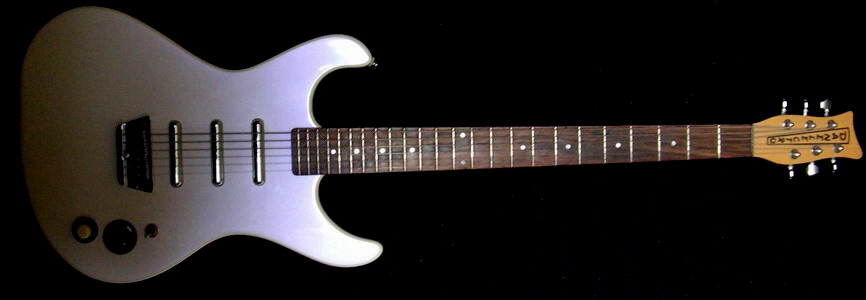
This quote is from Wikipedia: "The Baritone guitar is a variation on the standard guitar, differing with a longer scale length that allows it to be tuned to a lower range. The Danelectro Company was the first to introduce the Baritone Guitar in the late 1950’s. The Baritone Guitar was not originally a hit with either the general public, or the average guitar player. However, its unique sound quickly found its way into Surf music of the day, such as on some of the Beach Boys hits, as well as into background music for many movie soundtracks, especially the Italian Cowboy movies made in Europe starring greats like Clint Eastwood and Lee Van Cleef. The Baritone was also used by country artists and can be heard on recordings by Merl Haggard, Johnny Cash, and Willie Nelson........Gretsch, Fender, Jerry Jones, and many other companies have produced Baritone guitars since the sixties albeit always in low numbers due to low popularity."
Starting in the 1980s, post-punk avant hard rock bands such as Sonic Youth and the Butthole Surfers started tuning their guitars down to get a heavier, bassier tone. In the mid-1990s the seven-string was popularized by thrash-metal-funk bands such as Limp Bizkit and Korn. By the end of the decade the baritone guitar (and the seven-string) was used by many of the nu-metal, death metal and other heavy bands. The best known player for the baritone was Mike Mushok of Staind. By the new millenium, the baritone was associated with metal as much as it was previously associated with spaghetti westerns. country and surf music. Baritone guitars are most typically tuned a fourth below standard guitars using the same relative intervals between strings. With this tuning the baritone is tuned B-E-A-D-F#-B (low to high) with string gauges .013-.018-.028-.038-.050-.070. Tuning to a fifth below (A-D-G-C-E-A) is also fairly common. Scale lengths of baritone guitars are typically 26 to 28 inches, longer than the standard electric guitar scale length range of 24.75 (Gibson) to 25.5 inches (Fender). I have spotted baritone scale lengths as high as 30 inches, but 27 to 28 inches seems to be the most common.
Fender created a six-string bass in the 1960s called the Bass VI, which is often considered a type of baritone guitar. (Here's a good article on the Bass VI at www.vintageguitar.com) It is tuned an octave below a standard guitar, so it is similar to a four-string bass, except it has two additional strings at the high end (B and E). The scale length is typically 30 inches, and the neck width is narrow compared to most basses. I have a Schecter version of the Bass VI, the Hellcat VI, and I find it very cool and useful, but in my opinion, Bass VI style instruments should be considered a type of bass guitar, not a baritone guitar. The design attempt was to make a bass that felt familiar to players of standard guitars. (Reportedly John Lennon and George Harrison used a Bass VI to play bass with the Beatles when McCartney played piano.) My understanding of the intent of the baritone is to create an instrument for the pitch range in between the standard guitar and bass.
Even the staff at Fender seem to be confused about the difference between Bass VI-style instruments and baritones. Their Jaguar baritone is described as being a Bass VI type instrument but it is tuned to B and has a 27" inch scale which makes it a baritone, not a Bass VI type instrument. In fact, Fender has a Bass XI reissue instrument available that has a 30.3" scale.
Another instrument somewhat similar to the baritone guitar is the seven-string guitar, sometimes referred to as the seven-string baritone guitar. Modern electric seven-string guitars are most typically tuned like a standard guitar with the addition of a low B string (B-E-A-D-G-B-E). (seven-string guitars with an additional high string also exist) Scale lengths of 25.5-26 inches seem most common. Seven string guitars can be considered baritone guitars with an additional high E string and the overall sound is essentially the same. Although seven-string guitars seem to be a bit more popular than baritone guitars, my experience is that it is much easier for most players of standard guitars to adapt to the baritone, because the seven-string's wider neck is difficult to handle. In addition, the baritone allows standard guitar players the ability to use familiar chord shapes. With the seven-string, the player needs to determine how to work with the additional string. The bottom line is that if you feel that six strings are not enough for you, then a seven-string may be for you. If you only want to play a guitar with a lower pitch, then the baritone is probably your best choice.
Guitar maker Jim Soloway put it this way: "The advantage of a baritone is that there is no learning curve. You just pick it up and play just like you always have but you're automatically transposed down. The disadvantages are that 1) everything is now in a different key and 2) you lose the high end range of the instrument. The advantages of a 7-string is that 1) everything remains in the same key; 2) you increase the low end range of the instrument; and 3) You maintain the high end range of the instrument. The disadvantage is that there is a very real learning curve to really take advantage of the added range of the instrument. So which is a better option probably depends on your purpose and your level of commitment. If you want an instant payoff without a big investment in learning, then buy a baritone. If you want to make a greater commitment and you're willing to do some serious work, then get a 7-string."
In my experience, transposing keys is easy if you have a basic understanding of music theory. Although I agree that seven string guitar is more difficult, I think the two instruments are equally rewarding with some serious work. It should be your goals, not your level of commitment, that should determine which type of guitar is right for you.
This site will concentrate on the six-string baritone guitar, but I am sure that much of the information will also be relevant to players of seven-string guitars.
(End of Chapter One for now)
Your feedback and questions will guide the future of this site.
-Mike 064 Freeman
Contact Info
Oranj Productions Home
Page
All content Copyright 2007-09 Oranj Productions.
All Rights Reserved.